

Introduction to the battle of Spionkop (Spion Kop or Spioenkop)
The Second Anglo Boer War was fought between the British Empire and two Boer states. Firstly, the South African Republic (Transvaal Republic) and, secondly, the Orange Free State. The reasons were the Empire’s influence in South Africa and the desire to acquire the rich goldfields of these states. The ‘uitlanders’ had developed many of the mines in these states. This war is also referred to as the South African War.
At the outbreak of this war, the Boer commanders decided to besiege certain vital towns. These were in the Cape Colony and Natal to prevent a British invasion of their homelands.
General Sir Redvers Buller was put in command at the outset of the Natal component of the British war effort. He had urgently mounted a campaign to relieve Ladysmith’s siege and suffered a humiliating defeat at the Battle of Colenso. This battle took place on the 15th of December 1899.
The Battle
The Battle of Spionkop (Spion Kop or Spioenkop) fought over the 23rd and 24th of January 1900, represents the second of his four attempts to relieve Ladysmith. Also, the Battle of Spionkop was the scene of the most futile and certainly the bloodiest of the four battles.
The British believed that by traversing the hill of Spionkop, they could cross the mighty barrier of the Thukela (thunder in Zulu) River. General Louis Botha was using this as his defensive line. Therefore, a contingent comprised 1,700 men from the 2nd Lancashire Fusiliers, six companies of the 2nd King’s Own Royal Lancaster and two from the 1st South Lancashire. Additionally, 200 dismounted men from Thorneycroft’s Mounted Infantry were ordered to ascend this mountain on the evening of 23 January. Unfortunately, they failed on two occasions to entrench properly. Finally, at the crest of Spionkop, their second attempt resulted in trenches that ran parallel to the Boers’ Krupp and pom-pom guns on Aloe Knoll, Green Hill and Twin Peaks. What ensued was an absolute slaughter.

Control
Lieutenant Colonel Thorneycroft eventually managed to take control of the situation by shouting out to the Boers, ‘I am the commandant here, take your men to Hell, sir! There’s no surrender.’ These words and reinforcements – the Imperial Light Infantry and Middlesex Regiments – inspired the British forces. The Middlesex Regiments fixed bayonets and charged the Boers (a new tactic to them) – this effort forced the Boers to retreat beyond the crest. The Kings Royal Rifles, under the command of Major General Lyttelton, were also dispatched to seize Twin Peaks. Just after five o’clock, the King’s Royal Rifles, supported by naval gunfire from Mount Alice, managed to gain possession of the Twin Peaks, forcing the Boers’ pom-pom guns from the area. The British were now poised to drive the Boers off Aloe Knoll; from there, they could have made the conditions for those holding the northeast line extremely difficult.

Closure
However, at this crucial moment, Buller ordered a withdrawal of the Kings Royal Rifles for some obscure reason.
As dusk set in, Thornycroft was overcome by a feeling of desertion by General Buller and Warren. He saw a battlefield and trench littered with wounded, dying and dead men as he looked around him. They were all exhausted, thirsty and hungry. Even the Scottish Rifles, Imperial Light Infantry, and Middlesex Regiment severely needed rest.
He, thus, after conferring with his other senior officers, decided to order a retreat at 20h00. The Boer forces were similarly despondent and also withdrew from the battlefield. This dreadful day of bloodshed cost the British some 1,200 casualties, of whom approximately 300 died. In total Boer losses amounted to some 300 men, of which 68 died.

Location
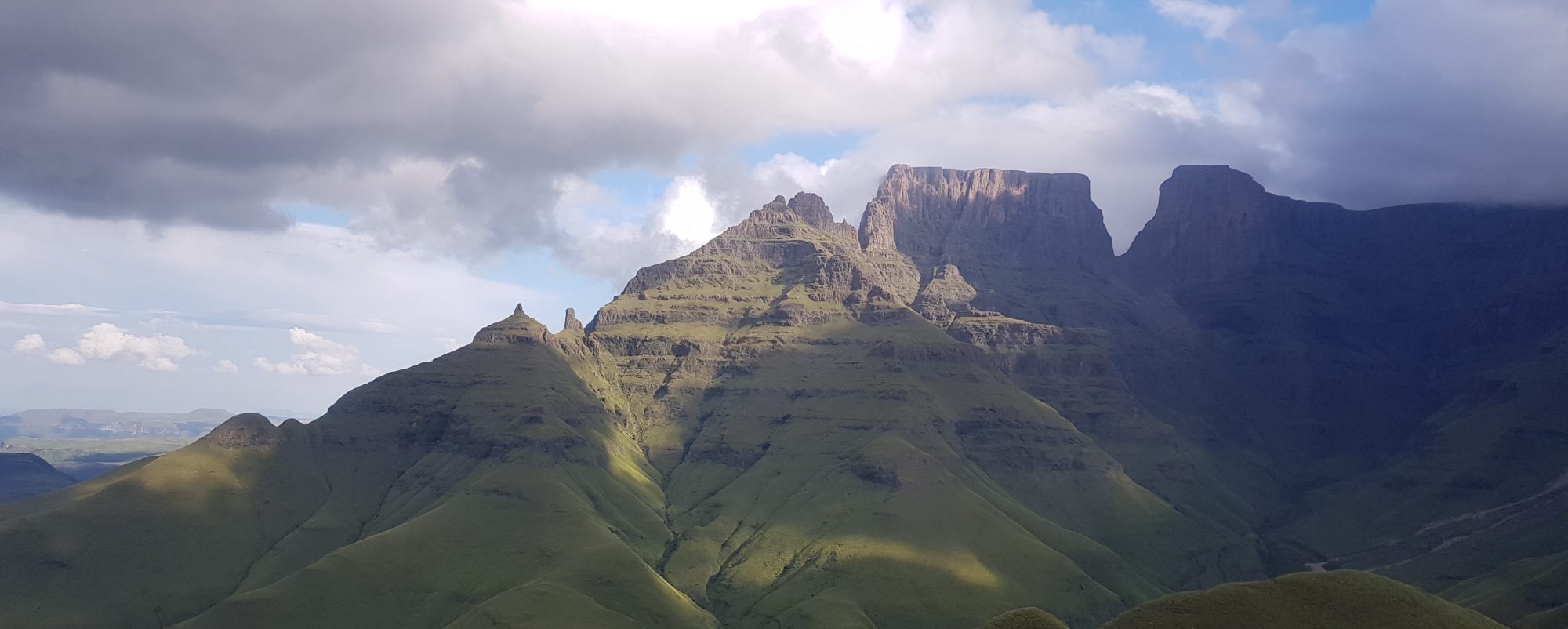
The Spionkop Battle Site is found at the end of a signposted short gravel road from the R616 to Bergville. Moreover, the R616 is easily accessible from the N3 at the Bergville/Ladysmith offramps. Furthermore, there are many specialist Battlefield Tour Guides who can provide a very enlightening overview of this battle. It is important to note that Spionkop also offers a panoramic view of the entire Northern and Central Drakensberg. The views of this world heritage site at sunset from this site are ‘breathtaking’.
Did you know?
- Firstly, an important memorial or stadium commemorating the Battle of Spionkop exists at the famous Liverpool Football Stadium, Anfield. Known as the “Kop” and pays tribute to the many soldiers from Liverpool and specifically the 1st South Lancashire Regiment, who held their position and died in the famous battle of Spionkop.
- Also, three of the most influential personalities of the 20th century, namely Mahatma (Mohandas, later to be named Mahatma) Gandhi, Winston Churchill, and General Louis Botha participated in the Battle of Spionkop. However, it is not clear that Gandhi was present on the ‘Kop’, it was likely he was in the close vicinity.
- Finally, a monument has been placed on Spionkop to commemorate the incredible sacrifice that the Indian community made to support the British war effort in the Anglo-Boer War.
