
Introduction

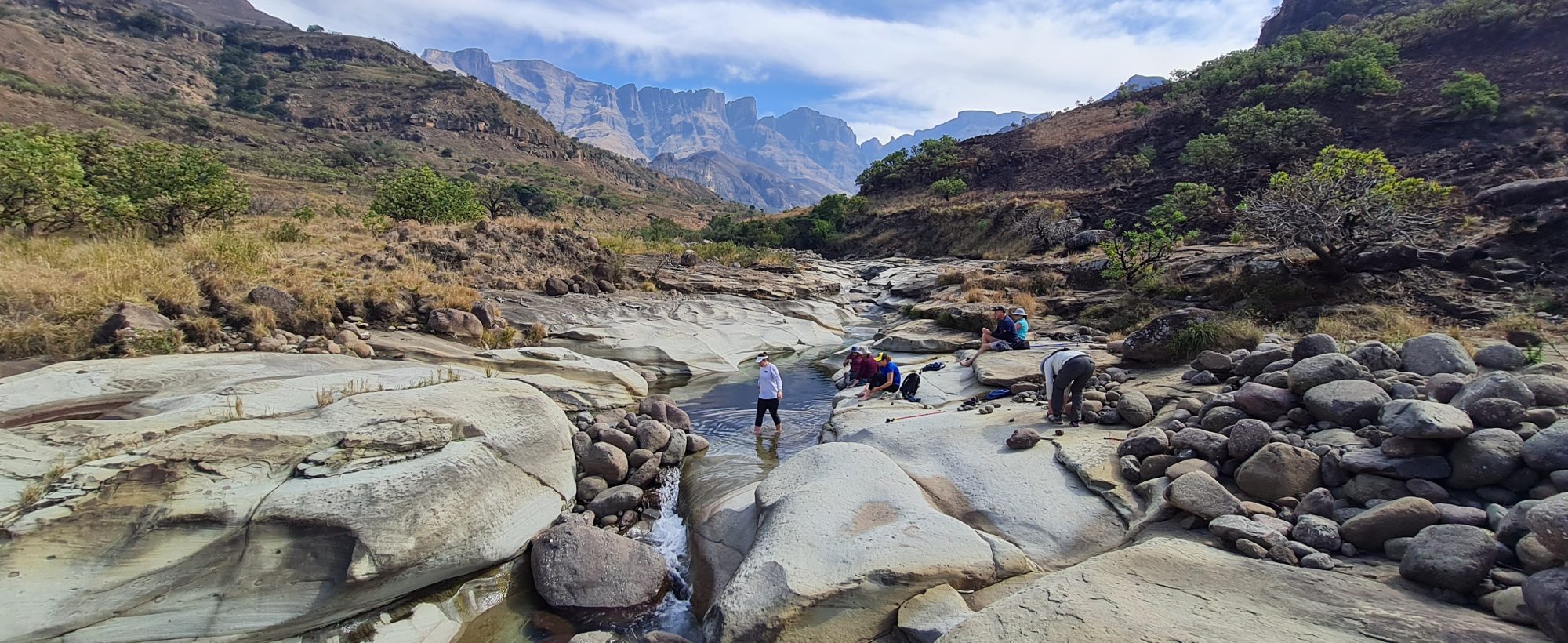
Cathkin Park, more commonly known to visitors as Champagne Valley, is one of the best-known tourism areas in the Central Drakensberg of KwaZulu-Natal.
Although commonly referred to as a valley, Cathkin Park is better understood as a broader geographical and tourism area extending from the foothills of the Central Drakensberg towards the dramatic mountain escarpment. It forms part of the Okhahlamba Local Municipality and lies approximately 30 kilometres from Winterton.
The area has a resident population of approximately 3,000 people and has developed into one of the principal centres for accommodation, adventure tourism and mountain recreation in the Drakensberg.
Looking towards the mountains from the valley, the skyline is dominated by a spectacular succession of peaks and ridges, including Champagne Castle, Monks Cowl, Cathkin Peak, Sterkhorn (Mount Memory), The Turret, The Amplet and Gatberg (Ntunja or the Eye of the Needle).
The area is much more than a tourism destination, however. Cathkin Park has a history extending from San hunter-gatherer occupation and later African settlement, through nineteenth-century European settlement, farming, forestry and mountaineering, to the development of modern conservation and large-scale tourism.
Cathkin Park or Champagne Valley mountain peaks
The mountains are the defining feature of Cathkin Park and Champagne Valley.
Among the principal peaks and features visible from the area are:
- Champagne Castle – approximately 3,377 metres
- Monks Cowl – approximately 3,229 metres
- Cathkin Peak – approximately 3,181 metres
- Sterkhorn / Mount Memory – approximately 2,973 metres
- The Turret
- The Amplet
- Gatberg (Ntunja or the Eye of the Needle)
- Dragon’s Back ridge
The mountain names themselves provide an interesting insight into the different cultural influences that have shaped the Drakensberg.
Monk’s Cowl is a descriptive English name, derived from the resemblance of the distinctive summit to the hood or cowl of a monk. The name was already established in mountaineering literature by the early twentieth century. A 1915 Alpine Journal account describes Monk’s Cowl as the distinctive pinnacle between Cathkin Peak and Champagne Castle and records the early attempts to climb it.
Cathkin Peak is associated with the name Cathkin used in the surrounding district. There is a long-standing tradition linking the name ultimately with Cathkin Braes near Glasgow in Scotland, although the precise documentary history of the naming still deserves further investigation.
Ntunja, the Zulu name associated with Gatberg, is commonly known in English as the Eye of the Needle.
The mixture of isiZulu, English and Afrikaans names reflects the successive cultural influences on the landscape.
A much older landscape
The history of Cathkin Park does not begin with the arrival of European settlers.
The Central Drakensberg was an important landscape for San hunter-gatherers, who lived, travelled and hunted throughout the mountains and foothills. Numerous rock shelters contain San paintings depicting people, animals and ritual imagery.
These sites form part of the extraordinary body of San rock art for which the Maloti-Drakensberg region is internationally recognised.
The nineteenth century also saw the settlement and movement of African communities through the foothills and valleys. The history of the area therefore includes San, amaZizi and other African communities before and during the period of European settlement.
This older cultural landscape remains visible today in the rock art, archaeological sites and indigenous place names of the region.
European settlement
The nineteenth century brought European settlement into the Central Drakensberg.
The Gray and Sclanders families are synonymous with the development of the ‘Valley’. Moreover, the Zunckel family. The Gray’s were the first to arrive in this area in 1854. They were a Scottish family who had travelled on the barque Aliwal in 1849. This ship almost ran aground near the present-day village of Umkomaas. The famous diving reef in this area is named after this vessel.
They (lead by David Gray) initially settled in the “Valley” after a few attempts to establish farms in the Midlands of KwaZulu-Natal. They founded Cathkin Farm. Cathkin Peak is named after this famous farm. Also, Andrew Gray established “The Nest Hotel”. Italian prisoners of war built this “grande old dame” of the “Valley”.
Patrick Sclanders, a friend of David Gray, took over ” The Nest” and married David Gray’s eldest daughter Mary.

David Gray
The Gray’s continue to live in Cathkin Park and operate a substantial sawmill and timber farm.
The name Cathkin itself has an interesting history. It is commonly associated with Cathkin Peak and the surrounding district, and there is a long-standing tradition linking the name with Cathkin Braes near Glasgow in Scotland. The precise documentary evidence for the naming, however, still deserves further investigation.
The landscape was already being used by African communities before these European farms were established. The present mixture of isiZulu, English and Afrikaans geographical names reflects the successive cultural influences on the region.
The beginning of mountain tourism
The first European visitors to the Central Drakensberg were not tourists in the modern sense. Explorers, surveyors, farmers, hunters and mountaineers gradually began to penetrate the mountains.
By the late nineteenth and early twentieth centuries, the dramatic peaks around Cathkin Park had become increasingly attractive to mountaineers.
The great objectives included Champagne Castle, Cathkin Peak and Monk’s Cowl.
The mountains were not easily conquered. Early climbers had limited route information and primitive equipment, and several of the major summits resisted attempts for many years.
The development of tourism and mountaineering went hand in hand. Visitors needed somewhere to stay, and the establishment of small hostels, guest farms and country hotels gradually created the foundations of the tourism industry that exists today.
Conservation and the Cathkin Forest Reserve
The conservation history of the area began early in the twentieth century.
The indigenous forests of the Little Berg were increasingly recognised as important not only for their ecological value but also for protecting the mountain catchments and water resources.
The Cathkin Forest was formally proclaimed as a reserve in 1922. Historical research into South African forestry records confirms that the Cathkin Peak Crown Forest was already demarcated in 1922, while forestry’s management objectives in the Drakensberg increasingly included catchment protection.
The establishment of these reserves was therefore about considerably more than timber production. State forestry increasingly regarded the high mountain areas as important for protecting the headwaters of rivers and maintaining the vegetation cover needed for healthy catchments.
Monk’s Cowl State Forest
The next major step was the proclamation of the Monk’s Cowl State Forest in 1927.
The protected area covered approximately 20,379 hectares, making it one of the substantial protected areas of the Central Drakensberg. The UNESCO documentation for the Drakensberg Park records Monk’s Cowl State Forest as having been proclaimed in 1927 with an area of 20,379 hectares.
The 1927/28 Annual Plan of Operations for Monk’s Cowl Crown Forest focused on objectives including protection of vegetation, prevention of overgrazing and control of activities that could damage the catchment.
This is an important distinction when describing the history of Monks Cowl. 1927 was the date of the formal State Forest proclamation, rather than necessarily the beginning of all forestry activity in the area.
The forest subsequently formed part of the much larger protected landscape that ultimately became the uKhahlamba-Drakensberg Park and, later, the Maloti-Drakensberg Park World Heritage Site.
The development of mountaineering
The great peaks around Cathkin Park became increasingly important objectives for South African mountaineers.
Gray’s Pass, providing access towards Champagne Castle, had been used as early as 1861, while the Stocker brothers made important early mountaineering attempts in the area during the late nineteenth century.
Cathkin Peak resisted early attempts and was eventually climbed in 1912.
Monk’s Cowl was another formidable objective. Early attempts were made from Monk’s Ravine and elsewhere during the first decades of the twentieth century. The 1915 Alpine Journal records several attempts and describes the peak as the distinctive, precipitous pinnacle between Cathkin Peak and Champagne Castle.
The standard route on Monk’s Cowl was established in 1942 by Hans Wongtschowski and his party. The story is recorded by Reg Pearse in Barrier of Spears. Oom Hendrik Maartens, who then owned Champagne Castle Hotel, apparently doubted that such a formidable-looking peak could be climbed and secretly sent a nephew up Champagne Castle to check whether the climbers’ summit cairn actually existed. It did.
These early mountaineering achievements helped establish the Central Drakensberg as a destination for adventure long before the modern adventure-tourism industry emerged.
Hendrik Maartens and Champagne Castle
Another crucial figure in the development of Cathkin Park tourism was Hendrik Maartens, affectionately known as Oom Hendrik.
Maartens recognised the tourism potential of his farm, Woestyn, and initially catered for members of the Natal Mountain Club, who camped on the property during mountain expeditions.
As the number of visitors increased, Maartens began providing more substantial accommodation.
Historical accounts differ slightly on the precise chronology of the early buildings, but Maartens had developed the property into a mountain hostel by the early 1940s. In 1940 he purchased the farm Woestyn and erected the first buildings that subsequently became Champagne Castle Hotel.
The hotel became an important base for hikers and mountaineers exploring the surrounding mountains.
Its location below Champagne Castle, Cathkin Peak and Monk’s Cowl made it particularly well placed to serve the growing mountain tourism market.
The Champagne Castle story is therefore an excellent example of how mountaineering generated the foundations of the hospitality industry in the Central Drakensberg.
Champagne Castle Hotel
The development of Champagne Castle Hotel marked an important transition from informal mountain accommodation to a recognised tourism establishment.
Maartens subsequently sold the property in 1943 to J. van Heynigen, who continued its development. Italian prisoners of war were involved in construction work during the Second World War, contributing to the buildings and rondavels associated with the hotel.
The hotel continued to develop as one of the best-known mountain establishments in the Drakensberg.
Today, Champagne Castle remains an important tourism base, and the hotel continues to provide access to hiking routes leading towards the Monks Cowl area and the surrounding mountains.
The Zunckels and Cathkin Park Hotel
Another family that played an important role in the development of Central Drakensberg tourism was the Zunckel family.
Reverend Karl Edward Zunckel emigrated to Natal from Berlin, Germany as a Lutheran Missionary in 1850. His Grandson, Otto Zunckel, married Mathilda Posselt, Granddaughter of Reverend C.W. Posselt who established the Emmaus Mission Station and Hospital in the Cathedral Peak Valley in 1847.
Otto and his 3 sons – Walter, Gerald and Udo – took part in many dramatic berg rescues in the mountains that form the frame of our valley during this time.
Otto Zunckel acquired the establishment associated with Cathkin Park Hotel in 1935. His sons Gerald and Udo Zunckel became involved in its operation, and Gerald and his wife Lilian subsequently ran the hotel for many years.

Gerald Otto Zunckel, one of the key founders of the hotel industry in the “Valley”. Source: The Mercury
The hotel became a popular holiday establishment and formed part of the growing network of family-run mountain hotels in the Cathkin Park area.
The Zunckel family are still a large and integral part of the Drakensberg, mainly represented in the farming community of Bergville.
Historical accounts indicate that the property was eventually incorporated into the later Drakensberg Sun development.
This provides an interesting continuity in the history of the valley: some of today’s major tourism developments grew from the much smaller family-run establishments that served the first generation of mountain visitors.
Drakensberg Sun
The development of Drakensberg Sun represented another major stage in the evolution of Cathkin Park tourism.
The Drakensberg Sun Hotel Share Block company dates from 1967, while the hotel itself opened in 1987.
This was a very different tourism model from the small hostels and family hotels of the earlier period.
Drakensberg Sun was developed as an integrated resort incorporating hotel accommodation, timeshare, recreation, conference facilities and a wide range of activities centred around its lake.
The resort helped broaden the market for the Central Drakensberg beyond mountaineers and hikers to include families, conference groups, corporate visitors and holidaymakers seeking a wide range of recreational activities.
A major fire damaged part of the hotel in 1988, only a year after its opening, but the affected areas were subsequently refurbished.
The resort later became part of the Southern Sun/Tsogo Sun group and underwent further major refurbishment.
From State Forest to the Natal Parks Board
The conservation history of the Monks Cowl area continued to evolve.
The 20,379-hectare Monk’s Cowl State Forest, proclaimed in 1927, became part of an increasingly comprehensive system of mountain conservation.
A major change occurred in 1986, when the Monk’s Cowl State Forest was transferred from the Department of Forestry to the Natal Parks Board.
This was an important change in emphasis.
The area was increasingly managed not simply as a State Forest, but as part of a broader conservation system concerned with:
- mountain grasslands;
- indigenous forests;
- wetlands;
- water catchments;
- biodiversity;
- wildlife;
- wilderness;
- archaeological sites;
- San rock art; and
- recreational access.
The subsequent development of wilderness areas, including Mdedelo and Mlambonja, added further protection to the high mountain environment.
Today, Monks Cowl is one of the principal gateways into the high peaks and the Mlambonja and Mdedelo (he who pushed over) Wilderness Areas within the uKhahlamba-Drakensberg Park World Heritage Site.
The place names of the Monks Cowl landscape
The landscape around Monks Cowl contains a fascinating mixture of African, English and Afrikaans names.
Hlathikhulu Forest, for example, derives from isiZulu and is generally understood to mean “large” or “great forest”.
Makhulumane Rock and Valley are associated with another established local geographical name. The name is variously written as Makhulumane, Makhulumani and Makhululmani. It is applied not only to the prominent rock but also to the forested valley and associated features.
The precise original meaning of Makhulumane has not yet been securely established, and it would be unwise to assign a translation merely from the apparent spelling.
Nandi’s Falls is another established name in the modern Monks Cowl trail system. The origin of this name is less certain. There is sometimes an assumption that the waterfall was named after Queen Nandi, the mother of King Shaka, but no reliable historical evidence has yet been found to substantiate that explanation.
These examples illustrate the importance of distinguishing between documented history and local tradition when interpreting Drakensberg place names.
The Drakensberg Boys Choir
The history of Cathkin Park would not be complete without mentioning the Drakensberg Boys Choir School.
The school was established in 1967 by the Tungay family, who were also associated with the development of Dragon Peaks Resort.
The school has become internationally recognised for its music and performances and has toured extensively overseas.
Its approximately 600-seat auditorium, constructed in 1995, provides an important cultural venue for the area.
The Drakensberg Boys Choir has become an important ambassador for the Central Drakensberg and South Africa, adding a strong cultural dimension to an area otherwise closely associated with outdoor recreation and adventure.


The modern tourism economy
Today, Cathkin Park/Champagne Valley is one of the most diversified tourism areas in the Drakensberg.
Major accommodation and resort establishments include:
- Champagne Sports Resort
- Champagne Castle Hotel
- Drakensberg Sun
- The Nest Hotel
- Gooderson Monks Cowl Golf Resort
- Cayley Mountain Resort
- Dragon View Lodge
- Mount Champagne
- Berghaven
- Mountain Splendour
- Ardmore Guest Farm
- Champagne Lane Resort
- Champagne Valley Resort
- Fernwood
- Dragon Peaks Resort
In addition, there are numerous smaller lodges, guest houses, country homes, bed-and-breakfast establishments, campsites, caravan parks, self-catering properties, timeshare developments and youth/backpacker facilities.
This diversity of accommodation is one of the area’s greatest tourism strengths.
Adventure tourism
Cathkin Park is particularly well known for adventure tourism.
Mountain activities
- Hiking
- Trail running
- Mountaineering
- Scrambling
- Abseiling
- Rock climbing
- Cliff walks
- Mountain biking
- E-biking
The Monks Cowl section provides access to numerous established mountain trails, including routes to Nandi’s Falls, Sterkspruit Falls and Blindman’s Corner, as well as longer routes into the Little Berg.
Other outdoor activities
- Fishing
- Horse riding
- White-water rafting
- Zip-lining
- Quad biking
- Scootours
- Hot-air ballooning
- Gliding
- Helicopter flights
The area also offers opportunities for wildlife viewing, birding, photography and nature interpretation.
Golf, culture, shopping and food
Cathkin Park is not solely an adventure destination.
Golf is available at Champagne Sports Resort and Gooderson Monks Cowl Golf Resort.
The area also has a growing range of cultural, retail and culinary attractions, including:
- Berg Air
- Drakensberg Brewery
- Chocolate Café
- Farm Friends
- Champagne Bistro
- The Oaks
- Cedarwood Shopping Centre
- Drakensberg Boys Choir
- Falcon Ridge Birds of Prey
- Dragon Rock Reptile Centre
- Deon’s Honey and Bee Tours
- Scrumpy Jack
- Thokozisa
The combination of mountain scenery, outdoor activities, accommodation, food, entertainment and cultural attractions makes Champagne Valley unusual within the Drakensberg tourism landscape.
The Oaks
The Oaks has its own place in the development of the modern tourism economy.
Established in 1984, The Oaks Supermarket, Gifts and Crafts was originally opened to meet the needs of visitors staying at Dragon Peaks Mountain Resort.
As tourism in Champagne Valley expanded, so did the need for a more substantial local shopping facility. The Oaks subsequently developed into an important service centre for both residents and visitors.
The business has been owned and managed by the Lanham family.
Its history is a good illustration of the way in which tourism development created opportunities for supporting businesses and services in the local community.
A century of change
The history of Cathkin Park and Champagne Valley is a story of transformation rather than replacement.
The mountains were first valued as a landscape of hunting, movement, settlement and cultural significance.
European settlement brought farming and new patterns of land ownership.
Mountaineers then began exploring the great peaks, creating a demand for accommodation and mountain infrastructure.
The Cathkin Forest Reserve was proclaimed in 1922, followed by the Monk’s Cowl State Forest in 1927, covering approximately 20,379 hectares.
People such as W. Carter Robinson recognised both the tourism potential and conservation importance of the mountains. Robinson’s hostel, established in 1929, provided an early base for visitors while his advocacy helped strengthen the case for protecting the mountain forests.
Hendrik Maartens subsequently demonstrated the commercial potential of mountain tourism through the development of accommodation that became Champagne Castle Hotel.
The Zunckel family helped establish the tradition of family-run mountain hospitality through Cathkin Park Hotel.
Later, Drakensberg Sun introduced a much larger resort model, combining accommodation, timeshare, recreation and conferences.
The transfer of Monk’s Cowl State Forest to the Natal Parks Board in 1986 represented another important stage, bringing the area more firmly into the modern conservation system.
Today, the protected mountain landscape forms part of the Maloti-Drakensberg Park World Heritage Site.
Cathkin Park today
Today, Cathkin Park and Champagne Valley are much more than a collection of hotels beneath spectacular mountains.
The area represents almost two centuries of changing relationships between people and the Drakensberg.
It contains evidence of the ancient San landscape, African cultural history, nineteenth-century farming, early forestry, pioneering mountaineering, conservation, family-run mountain hotels and modern large-scale tourism.
The 20,379-hectare Monk’s Cowl State Forest proclaimed in 1927 remains an important part of this story.
The pioneering work of people such as Carter Robinson and Hendrik Maartens, the contribution of the Zunckel, Gray, Sclanders and other families, and the later development of major resorts such as Drakensberg Sun all contributed to the evolution of the area into the tourism destination it is today.
The mountains remain the common thread.
Champagne Castle, Monks Cowl, Cathkin Peak, Sterkhorn, The Turret, The Amplet and Ntunja continue to dominate the landscape and provide the foundation for hiking, climbing, adventure tourism, conservation and nature-based experiences.
The story of Cathkin Park is ultimately the story of a remarkable relationship between mountains, people, conservation and tourism.
It is this combination of natural beauty, cultural heritage, adventure, hospitality and community that makes Cathkin Park and Champagne Valley one of the most important tourism landscapes in the Drakensberg.
Special thanks to Ann Gray and Delyse Ritchie (née Binney) for their contributions to the historical information contained in this article.