|
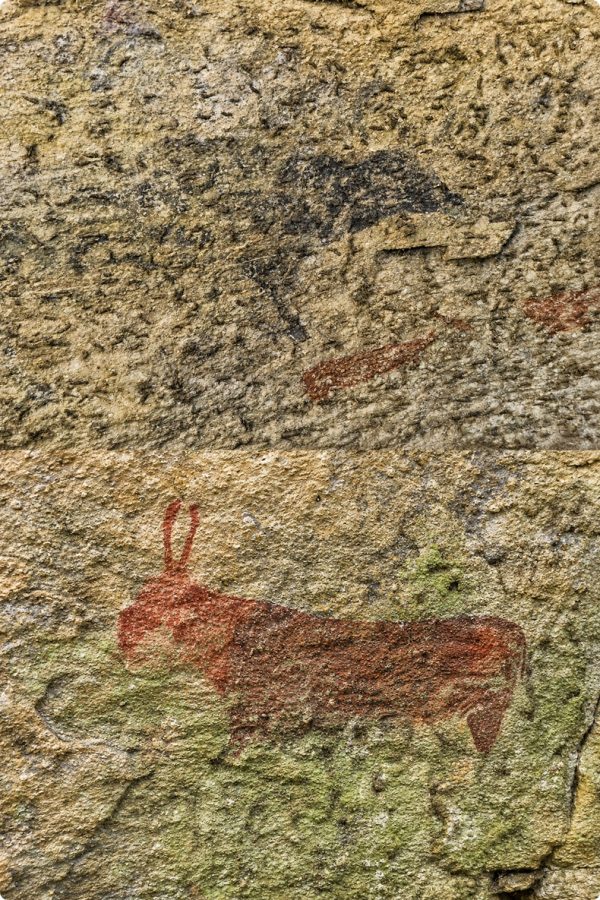
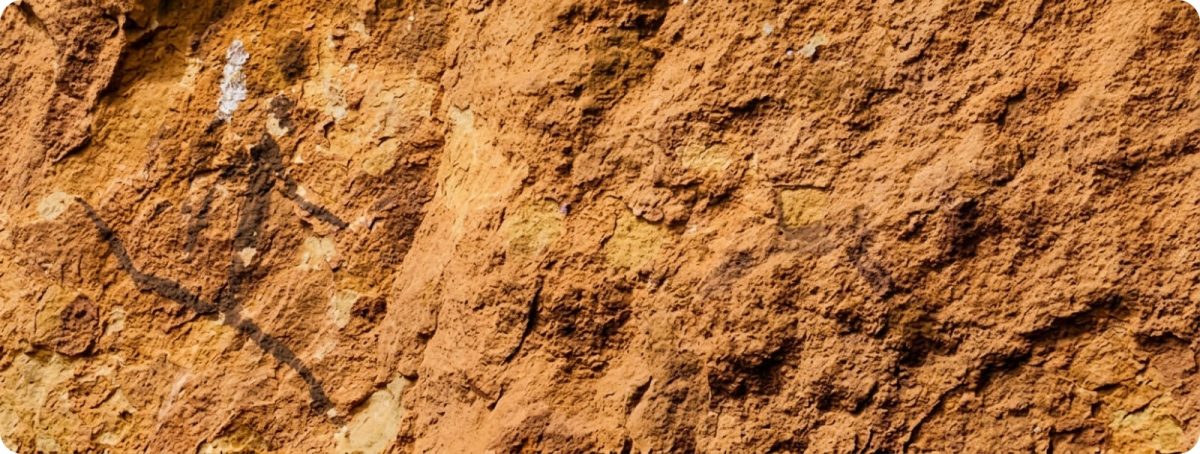
Earlier this year, while walking back from Bannerman’s Hut in the Central Drakensberg, I came across a faded but striking San rock art panel that immediately drew my attention. At first glance, it seemed simple enough — a dark outline on the sandstone wall. But the longer I stood there, the more the image revealed itself.
The panel shows what appears to be a human figure pursuing a baboon.
It is not a large or elaborate painting, and much of the finer detail has weathered away over time, but the composition remains clear. On the left is an elongated human figure, arm extended forward, seemingly in movement or pursuit. To the right is the unmistakable form of a baboon — broad-bodied, with bent limbs and a forward motion that suggests escape.
For many visitors, it would be easy to see this simply as a hunting scene. But San rock art is rarely that straightforward.
The baboon occupied a far more complex place in San belief than many people realise. While the eland is widely recognised as the most spiritually significant animal in San cosmology, the baboon carried its own powerful symbolism, often associated with protection, vigilance, danger and defensive strength.
Patricia Vinnicombe, in her landmark work People of the Eland (1976), demonstrated that San rock paintings are not simply records of daily life. Animals often represented spiritual power rather than literal hunting scenes. The baboon fits firmly into that category.
Baboons were distinctive creatures in the mountain world of the Drakensberg. They lived among cliffs and caves, places already associated with spiritual potency. They were fiercely protective of their troop, constantly alert, vocal in warning, and willing to confront threats much larger than themselves. They were also strangely human-like in posture and behaviour — familiar, but never entirely comfortable.
That combination made them symbolically powerful.
This is where the work of archaeologist Sam Challis becomes particularly valuable. His research on nineteenth-century Maloti–Drakensberg rock art explores the symbolic role of baboons in frontier-period San belief, particularly among the AmaTola Bushmen.
Challis links baboons directly to protective medicine and spiritual defence. He argues that baboon power was associated with medicines used for protection — not only against physical enemies but also against danger, harmful forces, and spiritual threats.
In this sense, the baboon represented defence.
Not defence in a purely physical sense, but something deeper: vigilance, warning, survival, protective strength and the ability to withstand danger.
Among both Khoe-San and neighbouring African farming communities, baboons were associated with powerful medicine. Some traditions held that baboons carried protective medicinal roots in the cheek, giving them unusual awareness and spiritual potency. Even in Xhosa traditions, related beliefs survive in the figure of uMabophe, linked to baboon-associated protective medicine.
Standing below that shelter this week, with baboons calling from the cliffs above, that interpretation felt entirely fitting.
This changes how the image can be read.
Rather than simply a hunter chasing prey, the panel may represent something more symbolic — a ritual engagement with baboon power.
San shamans entered trance during healing dances to access supernatural power, and in these altered states, the boundaries between human and animal became fluid. People could symbolically take on the qualities of animals in order to draw on their potency.
This is why therianthropes — part-human, part-animal figures — appear so often in San art.
The baboon, with its fierce protective nature and human-like qualities, was an ideal source of such power. Challis suggests that ritual specialists may have sought to take on baboon potency itself — its vigilance, its defensive strength, and its ability to guard against danger.
Seen in that light, the image above Bannerman’s trail may not be a hunting scene at all.
It may be a symbolic pursuit of protection.
There is another layer to this as well.
The nineteenth-century Maloti–Drakensberg was not a peaceful place. It was a contested frontier of cattle raiding, mounted commandos, displacement and survival. San communities lived under increasing pressure from settler expansion and conflict with neighbouring chiefdoms.
In that world, protective symbolism mattered.
Baboon imagery may have reflected not only older spiritual beliefs, but also the practical realities of resistance and survival. To invoke baboon power was to invoke courage, alertness and the ability to endure.
This gives the small faded image on that sandstone wall a remarkable depth. It is not simply a picture of pursuit. It may be a statement about protection, resilience and survival in a difficult world.
One of the privileges of walking regularly in the Drakensberg is that moments like this still happen unexpectedly. You round a bend on a familiar path, stop beneath an overhang, and suddenly find yourself standing in front of a conversation that began hundreds of years ago.
This small panel above Bannerman’s trail is one of those moments.
A hunter and a baboon. Or perhaps something more than that.
Perhaps a visual expression of protective power — a human figure confronting one of the mountains’ great sentinels, not simply to kill it, but to understand, invoke and share in its strength.
The longer I looked at it, the less it felt like a simple hunting scene, and the more it felt like a lesson.
In the Drakensberg, even a baboon can be a guardian. |